
A ‘Competitive Streak’ Guided Gleeson’s Journey to K
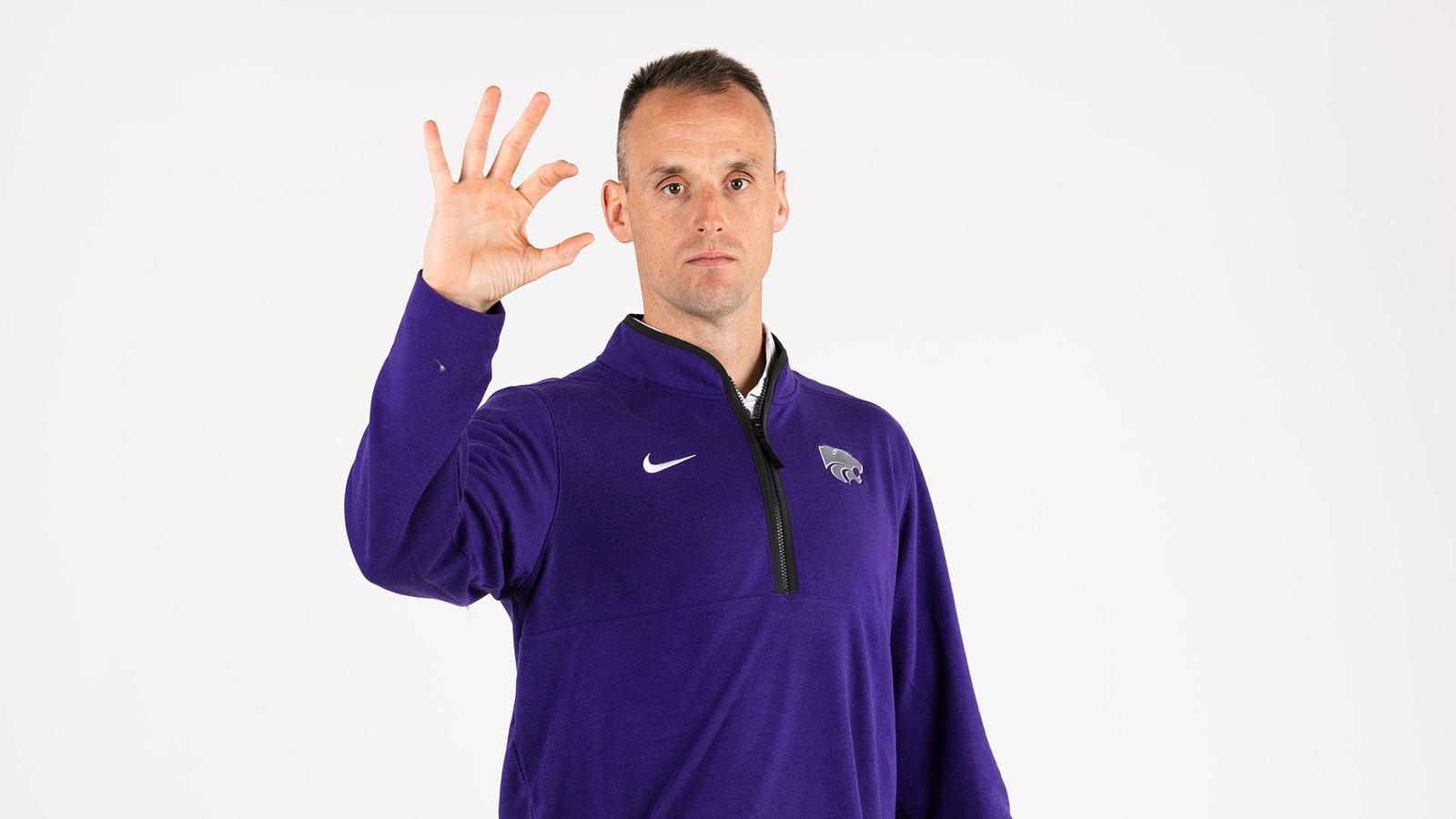
By: D. Scott FritchenYou ask Sean Gleeson about his work ethic. He points to his family. The 41-year-old Gleeson, a native of Glen Ridge, New Jersey, is the grandson of an Irish immigrant and the son of a devoted father who spent 20 years as a chef at the Holiday Inn before becoming an educator and coach.Work ethic? Gleeson fought his way to play quarterback at Division III Williams College, became the highest-rated passer in the league, took his team to an undefeated season, and also played first base on the Williams baseball team.He coached football, baseball and bowling at Delbarton School in Morristown, New Jersey, and took his first college job as Fairleigh Dickinson offensive coordinator in 2011.Today, Gleeson sits in a Powercat quarter-zip, one day removed from the official announcement that the former Missouri quarterbacks coach was hired by K-State head coach Collin Klein to serve as offensive coordinator for the Wildcats.Gleeson and his family drove in from Columbia, Missouri, on Saturday, after he served as quarterbacks coach for the Tigers each of the past two seasons.This marked Gleeson's first time in Manhattan. When he pulled open the front doors to the Vanier Family Football Complex on Saturday, he was impressed."Blown away, yeah, with the stadium, the coaches' offices, the locker room and weight room," Gleeson says. "I've been in three major leagues now — the Big Ten, the SEC and two Big 12 schools — but K-State, this place compared to the SEC, where everyone celebrates football and facilities and the stadiums and such, K-State has one of the best facilities I've ever been around."In six years at Princeton, serving almost all six years as offensive coordinator, Gleeson helped Princeton to three Ivy League titles, including a 10-0 mark in 2018, and their 36.9 points per game was the program's best six-year stretch in program history.Spending the 2019 season as offensive coordinator and quarterbacks coach at Oklahoma State, Gleeson oversaw a unit that ranked 17th in rushing, 21st in total offense and 35th in scoring offense. With Gleeson calling the plays, Consensus All-American running back Chuba Hubbard led the nation with 2,094 rushing yards before going in the fourth round of the 201 NFL Draft.At Rutgers, the Gleeson-led offense had the fourth-best improvement in the FBS by scoring 13.4 more points per game in 2020 than prior to his arrival. The Scarlet Knights were also the most improved offense in the Big Ten in total offensive touchdowns. Gleeson was a 2020 candidate for the Broyles Award as the nation's top assistant coach, and he mentored two NFL Draft picks in Bo Melton (Seattle) and Isaiah Pacheco (Kansas City).Gleeson went to Missouri after spending one year as senior offensive analyst at Northwestern. In 2024, Missouri ranked fifth in fewest passes intercepted, 10th in red zone offense, and 16th in third down conversions. In 2025, Gleeson kept together an offense that experienced its ups and downs while playing quarterbacks Beau Pribula and true freshman Matt Zollers due to injury.Nineteen years as a coach.Many explosive offenses during eight seasons as an offensive coordinator.After a couple conversations with Collin Klein, Gleeson is in Manhattan as offensive coordinator for the Wildcats."Collin has a great foundation with the things they've been doing at Texas A&M," Gleeson says. "This league for a long time was about open formations and fast football, and in the last three and four years when I left the Big 12, football has become even more complicated since that point. We all know the explosiveness of this league and the no-huddle things that people can do."But the level of detail that Collin has brought from his time over the last few years in the SEC, and perhaps working for a defensive head coach, there's just so much detail. Everything is very much buttoned-up that I think is going to combine his history and my history going forward in this league with a new landscape."Sean Gleeson spoke with K-State Sports Extra's D. Scott Fritchen about his experience with Collin Klein and his path to K-State.D. SCOTT FRITCHEN: When did you speak to Collin for the first time about this possibility of becoming offensive coordinator, and can you describe the process that led to you coming to Manhattan?SEAN GLEESON: It wasn't too long ago that Collin and I spoke. Probably a couple of weeks ago. We had some mutual connects in the business that got us in touch, and it took off from there. It's kind of easy in an interview setting to pick up from conversations you might've had a year ago or two years ago. We've known each other for quite some time now being in the business. Yeah, it was one of those things where maybe you didn't see it coming until you rewind in your head that, "Hey, we can see the steps that got us to this point."Some of the talk was just talking about SEC defenses and things we mutually faced this year, and some of the talk was about my role at Mizzou. But most of it was two coaches talking ball and trying to solve problems. We had a unique thing with Auburn this year where they were doing something defensively, a blitz package, on third down that Collin at Texas A&M had also faced against Auburn as well. We talked about that in our first conversation.I met Collin for the first time in 2019 when I was at Oklahoma State. I'd known of him as a player. During pregame, we said hello. It was Coach Klieman's first Big 12 game, and we were in Stillwater. Earlier that week, we were doing some research on the K-State staff, and I read about Collin, and then I bumped into Collin during pregame.FRITCHEN: How did he go about offering you the offensive coordinator position?GLEESON: He was just excited about the relationship forming and the things I'd bring to the table going forward, whether it be from a knowledge or work ethic standpoint. I was a guy who could support this program in its path forward. It didn't take long, to be honest, to decide to come to K-State. When you're in the Big 12 and look at the league and know the history of a place, there's always the scent of winning here, and playing tough, disciplined football. When Collin ultimately offered the job, that's what drew me here, was the opportunity to work with great players, a good quarterback, and to be in a winning environment.FRITCHEN: What were some things that Collin shared with you that particularly excited you?GLEESON: Just how disciplined of a program it was and its attention to detail. I could feel from him that that was super important, the value system that the program had. It's easy to do the Xs and Os, but it's a little bit easier to do that when you have that overarching program philosophy and discipline intact. He was made by his experience here with Coach Snyder, and he's prepared to pay it back to this program. Those are things I'm excited about.FRITCHEN: Obviously, something great has clicked between you and Collin already, like you two perhaps speak the same language when it comes to offensive football. What are the common philosophies you share when it comes to offensive preparation, execution and schematics?GLEESON: We're kind of still flushing that out, to be honest. He's got a great foundation with the things they've been doing at Texas A&M. This league for a long time was about open formations and fast football, and in the last three and four years when I left the Big 12, football has become even more complicated since that point. We all know the explosiveness of this league and the no-huddle things that people can do. But the level of detail that Collin has brought from his time over the last few years in the SEC, and perhaps working for a defensive head coach, there's just so much detail. Everything is very much buttoned-up that I think is going to combine his history and my history going forward in this league with a new landscape.FRITCHEN: Will you serve as play-caller, will Collin serve as play-caller, or how will that system work during in-game situations?GLEESON: It's his show. We're figuring out some of the role that I'll have.FRITCHEN: Exactly when did you make the drive to Manhattan? And what kind of things did you think about during your drive?GLEESON: We came on Saturday. I brought my family, and we took a peek at the area. It was fun. It was one of the first times in my coaching career where the next job was just a drive away, so that was nice. At Mizzou, we had airport trips to St. Louis and Kansas City, but I didn't get too far past Kansas City, so it was nice to get to the other side of it and see Manhattan and the landscape.FRITCHEN: How many times had you been to Manhattan previously?GLEESON: Zero. We played K-State in Stillwater in 2019, and I never had an opportunity to visit, but it's been great so far.FRITCHEN: What were your impressions the first time you opened the doors to the Vanier Family Football Complex?GLEESON: Blown away, yeah, the stadium, the coaches' offices, the locker room and weight room. I've been in three major leagues now — the Big Ten, the SEC and two Big 12 schools — but K-State, this place compared to the SEC, where everyone celebrates football and facilities and the stadiums and such, K-State has one of the best facilities I've ever been around.FRITCHEN: What was the first order of business when you entered the building for the first time?GLEESON: Just getting a lay of the land, walking around, trying to get your bearings, and walking to the indoor facility, and it was fun walking on the field for the first time. My kids were out there with Collin's kids, and they were tackling each other every 10-15 yards, so that was kind of fun. Yeah, we toured the building, and I saw where my office was, and we explored some of the other floors.FRITCHEN: Obviously, college football is moving fast these days. When you hear the words "transfer portal" what's the first thing that comes to mind?GLEESON: A very fast-paced recruiting environment. Everyone talks about the implications on improving your roster. It's like, "OK, I can get this guy." But one of the things I've reflected on is that high school recruiting used to be recruiting a kid for 12-14 months. In the portal world, sometimes you rely on the prior relationships that you have in recruiting a kid through high school, and he doesn't pick you then comes back like a boomerang. There are times you're trying to figure out someone's character through recommendation or word of mouth, but really within the 24-hour visit. All of that has sped up recruiting. Transfer portal last week was a week's time to reshape a quarter of your roster, and that goes from evaluation, transportation to getting them on campus and getting to know what makes them tick, then you have to make a decision, and maybe even negotiate. Everything was super-fast. You have to make sure you're picking the right guys.FRITCHEN: How has the transfer portal benefitted K-State to this point in time?GLEESON: I'm still learning a little bit about the roster, but what everyone hopes for is that the guys we've taken over the last week are going to get us to the point where we want to be, which is competing for championships in this league and getting to the College Football Playoff.FRITCHEN: How would you describe the past week inside this building?GLEESON: Unbelievably cohesive. I'm one of the last coaches here, and we've all come from different places. In the short conversations we've had about recruiting and football, there's been some great connections so far, and we're all excited about the future.FRITCHEN: Collin says you're hard working and competitive. Describe your work ethic.GLEESON: My dad was a chef at a Holiday Inn for almost 20 years. My grandmother was an immigrant from Ireland who left her whole family to come to the United States. I worked as a janitor for seven summers in high school and college. I learned a right way to do things, whether it was the detail, or hours required to do a job. Yeah, I only know one way, which is going above and beyond the call of duty. That's how I've earned responsibility in my career and how I've done a good job at the places I've been. Whatever it takes.FRITCHEN: How would you describe yourself a competitor?GLEESON: You enter the profession, coaching in Division III and every step of the way I've tried to win and continue to elevate wherever I've been. That only occurs if you have an elite competitive streak within you. What makes me compete these days, now 20 years into the profession, is just a level of obligation to the players. That's what has satisfied me, is seeing them reach their potential and rewarded for their efforts and getting wins on gameday. Beyond the "I want to win" thing, I'm doing a lot of that stuff for the players.Practice for me is where some of that competitiveness has to come through. On gameday, you're passing the baton a little. Certainly, you get the same feelings in pregame, but as a responsible coach, you have to get the headset on, quiet your mind, and make decisions in a short amount of time that impacts the game. In the booth or on the field, I keep a level head on gameday.FRITCHEN: When did you meet Avery Johnson for the first time?GLEESON: When I first arrived. He was up there in the building watching some video. It was great to meet him. I haven't seen too-too much. Most of the time, we catch a bit of a game while you're sitting in a hotel waiting for your opponent, or a highlight at night. But I know the name for sure, and I know some of the great things that he's done in a couple years here. I'm really excited to help him in any way that I can.FRITCHEN: There are so many statistics and numbers out there to measure the success of offenses. What are the first numbers you really look when evaluating the effectiveness of an offense?GLEESON: Wins are what matter the most, right? You can point to a bunch of different things. Our number one job on offense is to score points. The statistic I always look at is points per possession — how many times we've gotten the ball and what have we done with it. Ultimately, if we're doing our job, whether it be personnel packages, different plays, tempos at which we play, we have a job to score points. If those endeavors lead to wins, that's what we're looking for.FRITCHEN: Just to back up, you served as offensive coordinator and quarterbacks coach at Oklahoma State, then offensive coordinator and quarterbacks coach at Rutgers, then senior offensive analyst at Northwestern, then offensive analyst and quarterbacks coach at Missouri. How did those opportunities along the way help shape you into the coach you are today?GLEESON: Everything is cumulative. I tried to be a sponge. I come from a family of educators. Dad was a chef and then went into teaching and coaching after he was out of the hotel. My grandfather was an educator. You approach the job with some humility and know that you don't know everything about football, teaching and coaching. You take what you can from the people you work with and players you work with and continue to improve. There were points in my career I felt I had things figured out, but you realize you have more to go. Some of the improvement that I've personally made have been in good years and sometimes we learned a ton of stuff that nobody would know in times that we struggled. It's about continuing to approach this job like this is a learning environment, and we're doing the best we can to put the product on the field going forward. I learn every day on the job.FRITCHEN: What do you consider your biggest strengths as an offensive coordinator?GLEESON: Organization. There's been many years in my career where I've tried to hit the sweet spot between what's happening in games and how much we're practicing things and preparing our players. We put a ton of work into that. One of the things about being a former quarterback in understanding defenses, that started on the secondary level, but as you become more of an expert, you get into the bones of the front and some of the play-calling tendencies people have. One of the things I've done a good job of in recent years is transplanting from what I'm learning from defense, so watching tape, and getting into play calls that we have in the correct situations in the game, and trying to hit that nail on the head perfectly. There's a defensive ID perspective that I'll bring into some of the plays that we run.FRITCHEN: What's one thing everybody should know about Sean Gleeson?GLEESON: I'm excited to be here, number one. What the people are going to get from me is a hard-working, energetic guy who's going to do right by the players, and be a person that his co-workers want to be surrounded by.FRITCHEN: From that boy growing up in Glen Ridge, New Jersey, to where you sit today, what has Sean Gleeson learned most about himself along his journey?GLEESON: That's a great question. I have a love of sports that seems to not diminish, whether it's looking up to Phil Simms, watching him, and then moving my love of quarterback play to Tom Brady for a while, and now being, obviously, in this career where my sons are getting to watch games that I'm coaching in, there's a family love of sports and competition that I've lived 41 years on this earth. It's fun to keep doing that and passing it along to my kids, too.


.jpg)
Most Popular


Ayush Mhatre: Now boarding Virar fast
8 hours ago