Winter Olympics 2026: How Eileen Gu divides opinion
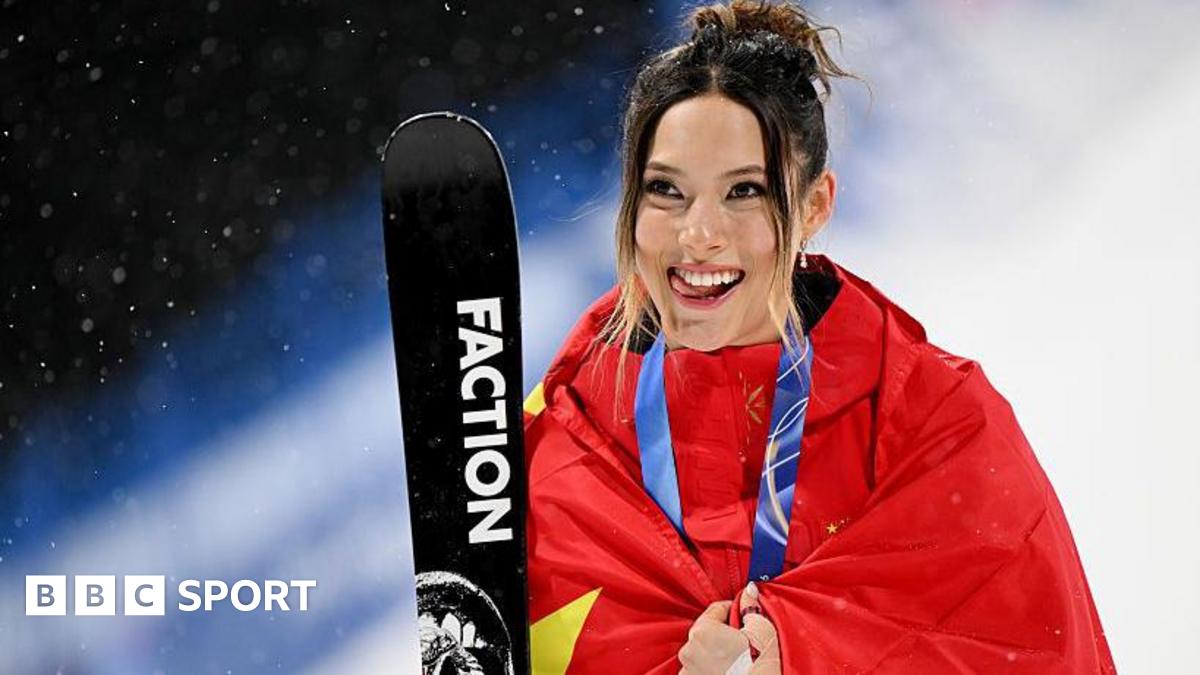
Wherever Eileen Gu goes, her fans will follow. Headlines will too.With five medals - and the opportunity for one more on Saturday - she is the most decorated female Olympic freestyle skier in history.But she is also someone who transcends her sport, a 22-year-old global superstar with a bank balance to make your eyes water.China fell in love with its 'snow princess' at the Beijing 2022 Olympics where, as the poster girl of the Games, she duly delivered.She became freestyle skiing's youngest Olympic champion with her big air and halfpipe golds at the age of 18, and the first to win three medals at the same Games when she added slopestyle silver.Later that year, she was named one of Time magazine's 100 most influential people in the world."I just like being the best. I've always wanted to do that," said Gu at the Milan-Cortina Olympics, where she has added two more silver medals to her Olympic collection."I wanted to be the best at math when I was in kindergarten, and then I wanted to get into the best high school, and I wanted to have the highest SAT score, and then I wanted to get to the best college, and I wanted to be the best skier I could be."Then I wanted to do every event, and then I wanted to win them all. When you get a taste of it, it's kind of addictive."On and off skis, Gu is a high achiever in every part of her world.California-born and raised by an American father and Chinese mother, she attended private school in San Francisco and is currently taking a sabbatical from her studies at Stanford University, where she majors in international relations and previously studied quantum physics.She is also fluent in Mandarin, and as a child would spend summers in Beijing."Sometimes it feels like I'm carrying the weight of two countries on my shoulders," Gu said earlier in the 2026 Games.In 2019, at the age of just 15, she switched her sporting allegiance from the US to China, wanting to "inspire millions of young people in Beijing - my mother's birthplace" before the 2022 Olympics.Whatever her reasoning, it was a decision that proved lucrative.In December, Forbes ranked Gu as the fourth-highest paid female athlete for 2025, behind only tennis players Coco Gauff, Aryna Sabalenka and Iga Swiatek.But unlike those three, only a tiny amount of her $23.1m (£17.1m) income last year came from prize money from her sport - around $100,000 (£74,000).Instead, it comes through endorsements with brands such as Red Bull, Porsche and Tiffany & Co, while she has walked the runway for Louis Vuitton and Victoria's Secret and is signed by modelling agency IMG.It also emerged in 2025, as reported in the Wall Street Journal, external, that Gu and another athlete were set to be paid a combined $6.6m (£4.9m) by the Beijing Municipal Sports Bureau.In total, the two athletes were said to be paid nearly $14m (£10.4m) over the past three years by the Bureau.But her decision to compete for China was also one that drew much criticism, not just because of China and the US' rivalry as the world's two biggest economies, but because of China's authoritarian Communist Party rulers and its poor record on human rights - which it denies.While the initial furore died down, it has raised its head again at these Games.At the start of the Olympics, American freestyle skier Hunter Hess spoke out about the actions of the United States' Immigration and Customs Enforcement (ICE) organisation and ongoing tensions in the US.In January, intensive care nurse Alex Pretti, 37, and fellow Minnesota resident Renee Good, 37, were both killed by ICE agents in the city, sparking widespread protests.Asked what it means to represent the USA, Hess said: "It's a little hard."Just because I'm wearing the flag doesn't mean I represent everything that's going on in the US."President Donald Trump responded to Hess' comment by calling him a "real loser", and Gu was one of several athletes who publicly defended Hess and others speaking out."As someone who's been caught in the crossfire before, I feel sorry for the athletes," she said.But that enraged her critics, given Gu chose to speak out against Trump but has never criticised China.Former NBA player Enes Kanter Freedom called her a "traitor", adding she "was born in America, raised in America, lives in America and chose to compete against her own country for the worst human rights abuser on the planet - China"."You don't get to enjoy the freedoms of US citizenship while acting as a global PR asset for the Chinese Communist Party," he wrote on X.When asked about China's human rights record by Time magazine, external, in an interview published in January, she answered: "I'm not an expert on this."I haven't done the research. I don't think it's my business."Gu has 2.6m followers on Instagram, has amassed 11.7m likes on TikTok, and at the Livigno Snow Park high up in the Italian Alps, no athlete has more fans in attendance.Clad in the red colours of China, they line the front of the fan areas, flags adorned with images of Gu's face pegged to the fences, and celebrate her every run like it has clinched Olympic gold.After every run, the ever-driven and disciplined Gu seeks out her mother, Yan, to review video footage on her phone. Yan, reportedly a successful venture capitalist who brought her daughter up single-handledly, is accredited at the Games and is the first person Gu celebrates her successes with.During Monday's big air final, Yan was seen watching alongside former International Olympic Committee president Thomas Bach.After competitions, Gu is the one every media outlet wants to speak to, and she gracefully and politely obliges as she slowly shuffles through the mixed zone.But it was from a press conference earlier this week that her remarks to a journalist went viral, when she was asked if she felt her two silver medals were actually two golds lost."I'm the most decorated female freeskier in history. I think that's an answer in and of itself," she replied."How do I say this? Winning a medal at the Olympics is a life-changing experience for every athlete. Doing it five times is exponentially harder because every medal is equally hard for me but everybody else's expectations rise, right?"So the two medals lost situation, to be quite frank with you, I think is kind of a ridiculous perspective to take."I'm showcasing my best skiing, I'm doing things that quite literally have never been done before so I think that is more than good enough. But thank you."In the lead-up to the Games, Gu did interviews with the likes of Vogue and Time magazine, but it was reports in the Swiss media, external that had the potential to further fuel a competitive rivalry at the top of the sport.It was reported that the coach of Swiss skier Mathilde Gremaud left her team to join Gu's on the eve of the Games, just as he had four years earlier before Beijing 2022.At those Games, Gremaud pipped Gu to slopestyle gold, while Gu won the big air title with Gremaud taking bronze.This time around, Gremaud again won slopestyle gold, with Gu taking silver, while the Swiss star withdrew from the big air after a crash, with Gu going on to finish second again.Before that big air final and as a result of reaching it, Gu had taken to Instagram to highlight a scheduling issue.It meant, as the only woman competing in three freeski events, she would miss a full day of halfpipe training. After appealing to the International Ski and Snowboard Federation (FIS) for another opportunity to train, she said she had been turned down."This decision is disappointing to me because it seems to contradict the spirit of the Games," she said."Daring to be the only woman to compete in three events should not be penalised. Making finals in one event should not disadvantage me in another."BBC Sport understands Gu had already been handpicked as one of 10 athletes - five men, five women - invited to a halfpipe testing training session, while having three official training sessions is more than the usual two held before World Cups.In a statement, FIS told BBC Sport: "For athletes who choose to compete in multiple disciplines and/or multiple events, conflicts can sometimes be inevitable."So serious is Gu taking these Olympics that she has brought 21 pairs of skis with her to Livigno, seven per event. Asked by BBC Sport how many she would normally take to a competition, she replied two or three.In the halfpipe training she did do she looked in imperious form, and qualified for Saturday's final in fifth place, with Great Britain's Zoe Atkin, also a Stanford student, topping the standings."My sixth Olympic final. I am proud to have a 100% success rate," Gu told BBC Sport."It is not an easy thing to do. The Olympics brings out the best and worst in people."Being able to withstand that pressure is something I am really proud of."


.jpg)
Most Popular