
From 2010 Asian Cup champions to football executives: Trailblazers guiding the Matildas’ next trophy
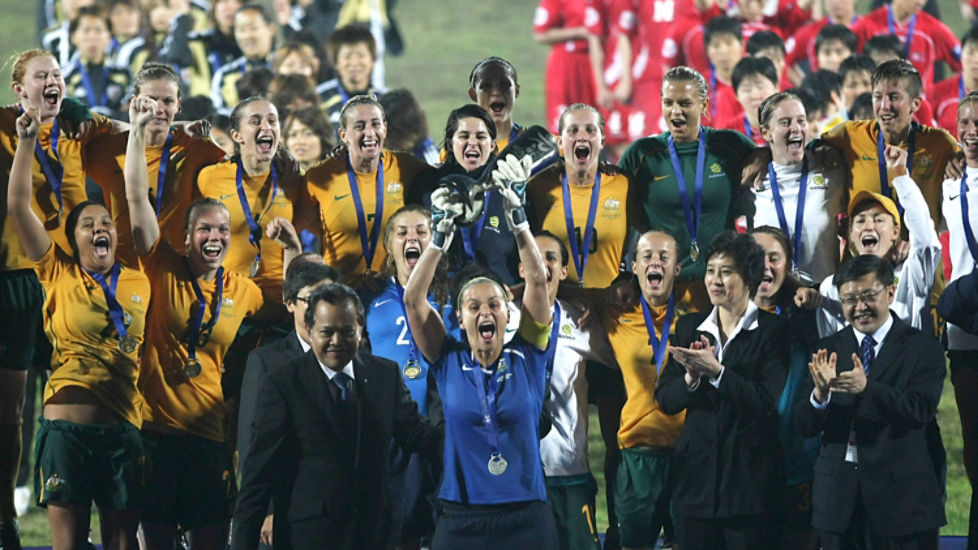
A breakthrough that still defines the MatildasThe CommBank Matildas have only lifted the AFC Women’s Asian Cup once.That breakthrough came in 2010, a defining night in Chengdu that delivered Australia’s first major international women’s title. Sixteen years on, it remains the only one.For Heather Garriock, now Football Australia’s Deputy CEO, the memory still resonates, not just as a former player, but as someone who has watched the game evolve from the inside.“As a player that played for the Matildas for over ten years and 130 times for my country, there’s just so much pride oozing out of me, even thinking of where we’re at today and the possibilities to come for the Asian Cup,” Garriock said.Back in 2010, however, the landscape looked very different.Sarah Walsh, now COO of the AFC Women’s Asian Cup 2026 Local Organising Committee, remembers just how difficult that title was to win.“That was Australia’s first piece of silverware. It’s very hard to do and so hard it hasn’t been won since. It tells you how competitive it is in Asia.”Winning against the oddsWhat made it even more remarkable was the context. The Matildas were still operating in a semi-professional environment.“Somehow we’ve been able to get the results as a semi-professional team,” Walsh said.And when they returned home as continental champions, the reception was sobering.“I was expecting mass media when we got home… but if our families weren’t there it pretty much would’ve been no one.”On the field, the road to the title required belief under pressure. In the final, three first-choice forwards were unavailable, one of them being Walsh, forcing the team to look elsewhere for solutions.The responsibility shifted to youth, in what was already a very young team, the average age being just 22.Among them was a 16-year-old Sam Kerr, already showing signs of the career that would follow.“Sammy always had this X-Factor about her,” Garriock said.But talent alone did not carry that team. It was a culture built on collective sacrifice, a willingness to put ego aside.“It didn’t matter what position he [former Matildas coach Tom Sermanni] asked you to play, it didn’t matter what role you had to play within the team. You want to do it because you wanted to do it for each other.”When the title was secured, the emotion reflected more than just a single match.“We didn’t win much in the Matildas. But that moment really goes down in history.”Garriock didn’t realise it at the time, but reflecting on her role in the beginning of something special still brings her to tears.“I get emotional… more emotional that I know what I’ve known now, the journey that the players have built and the path that the older girls have paved,” Garriock said.“It’s just incredible to see where the Matildas are at today. And we all had a part to play.”From limited recognition to national spotlightFor Walsh, being part of that 23-player squad created a lifelong connection, one forged in circumstances far removed from today’s spotlight.“To be one of the 23 women that won it, we will always have that bond.”Yet she is candid about the contrast between achievement and recognition at the time.“When you get success without the investment, without the eyeballs that are around you, it’s not that satisfying.”It wasn’t until the 2023 FIFA Women’s World Cup, amid record crowds and global attention, that she felt the broader shift in perception.“I was more satisfied in 2023 when I didn’t have to explain to people that women’s football was commercial.”A tournament that means more than a trophyThat evolution now sets the stage for what comes next.Australia will host the AFC Women’s Asian Cup 2026™, a milestone that speaks to the game’s transformation.For Garriock, the tournament represents something broader than the pursuit of another trophy.And in a multicultural nation, the spectacle will extend beyond the home side.“I’m so excited to see the CommBank Matildas play at the Asian Cup, but I’m just as excited to see the other Asian nations compete,” Garriock said.“We are going to see different nations, different cultures within the stadiums. And just to see the diversity within our country, I think that’s going to be really special.”Sixteen years after that breakthrough in Chengdu, the CommBank Matildas are chasing just their second Women’s Asian Cup crown, with belief from top to bottom that it can be done on home soil.Together, CommBank and the AFC are uniting fans across Australia and the region for the AFC Women’s Asian Cup Australia 2026TM. For more information visit commbank.com.au/football and womensasiancup2026.com.au

.jpg)
Most Popular
Bangladesh squad named for Pakistan ODI Series
4 hours ago


No. 1 Buckeyes Topped by No. 10 Baylor 4-2
4 hours ago