Morocco Honors Regragui, Entrusts Ouahbi with Elevating His Legacy of Excellence
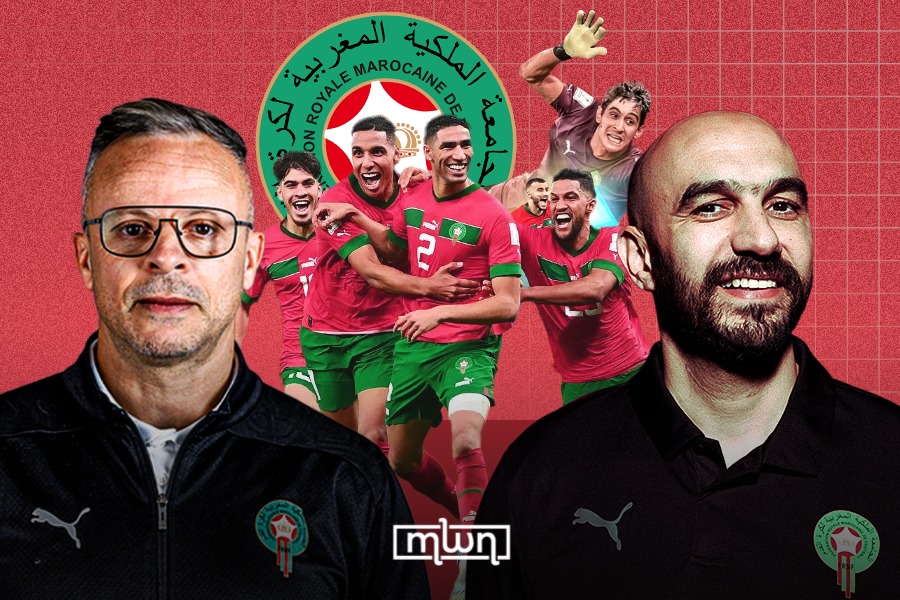
Ladies and gentlemen, take out your handkerchiefs to mark the momentous change of leadership taking place at the summit of Moroccan football as the country projects a radical vision of innovative continuity. As last week saw the confirmation of the identity of our national team’s new head coach, one could almost have imagined the royal guards breaking into Jacques Brel’s enduring relevant “Ne me quitte pas,” pleading with the departing, rightly valued (and now former) national coach not to let the flame die out.There was thus in the air that feel of a distinctly Brazilian saudade: a blend of gentle melancholy, longing, and the quiet joy of having lived through something truly unique. For even after the confirmation of his departure, he will never truly leave us. His name, now associated with the Atlas Lions’ historic and pride-inducing journey in Qatar and their globally reassuring AFCON journey at home, will forever be etched in our hearts.He leaves behind a record that commands respect and silences debate. Walid Regragui boasts a dizzying record in 49 matches at the helm of the Atlas Lions: 36 victories, 8 draws, and only 5 narrow defeats. Yet beyond this cold arithmetic, his true legacy is the mental revolution that has taken shape in the way Morocco’s team plays and projects itself. Regragui is the man who killed the “underdog syndrome” that used to hurt or undermine Morocco’s vision and ambitions on the global sporting stage.Regragui killed the underdog mentality that once prevented Moroccan Lions from roaringBefore him, Moroccan players stepped onto the pitch armed with a dictionary of excuses. But now, and increasingly so since their odds-defying displays in Qatar, Morocco’s team walks onto the playing field with a plan of conquest. Above all, under Regragui’s leadership, players relearned how to wear the jersey with honor, pride, and dignity. His leadership turned the red shirt, which players once perceived as a mere piece of sportswear, into a sacred armor for an honorable defense of the fatherland.Simply put, Regragui was the man who shattered the glass ceiling. He was the icebreaker that our football needed, carving out a royal pathway where most saw nothing but insurmountable barriers. He leaves behind a national side firmly entrenched among the world’s Top 8, having turned it into a machine that no longer trembles before decorated or world-class opponents.Yet beyond the numbers, it is the solemnity of the gesture that deserved recognition as Morocco’s Royal Football Federation duly celebrated a departing Regragui. Last week’s departure ceremony at the Mohammed VI Football Complex indeed marked a historic first, one that soothes old wounds of collective memory. Too often, our builders have exited the stage through the back door, consigned to the icy anonymity of a press release or the indifference that follows a perceived defeat.One cannot help but recall with a pang of sorrow the late Mehdi Faria and Henri Michel, as well as Badou Zaki and Hervé Renard – all of whom departed amid remorse and regret, carrying their achievements away in an unjust silence. Moroccan football honored itself by honoring Walid Regragui. It proved that it has become an institution capable of memory, gratitude, and dignifying gestures. It has shown that it will no longer dismiss or discard the legacies of our national heroes; it will rather embrace, celebrate, and magnify them.As the lights of last week’s tribute ceremony begin to flicker, one can almost hear in the promising air of Moroccan football the “Hello, Goodbye” refrain as carried by the clear, vibrant voice of Paul McCartney in his prime. His was an imperial voice rising between two eras to proclaim: “You say goodbye, and I say hello… Hello, hello!” And so: farewell Regragui, and welcome Ouahbi.Ouahbi and the imperative of competenceWho, then, is the Atlas Lions’ new mentor charged with sustaining and hopefully surpassing Regragui’s proud, rich and gratifying legacy? Like his celebrated predecessor, our new head coach is from within the system. Already crowned U20 world champion and a pure product of the national federation’s new vision of cultivating local expertise, Mohammed Ouahbi is the ultimate guarantor of this necessary change in continuity.He does not come to sweep everything away, but to instill a genuine culture of performance. In other words, his assignment is not to stage a revolution, but to successfully initiate a natural evolution on the sound, solid foundations his predecessor has left behind. There will hence be no room for sentiment or vested privileges as Ouahbi sets about building a working team whose leitmotif rests on two pillars: competence and professionalism. The era of trial and error is over at the helm of the Atlas Lions; this is the time for taking to completion or fruition the vision of sporting engineering now governing Moroccan football.Ouahbi as a visionary heir of Moroccan football’s newfound ambitionsHis strategy rests on a precise triptych meant to sow the seeds of a bountiful harvest at the upcoming World Cup in June this year: excellence as a guiding principle. Mohammed Ouahbi is surrounding himself with highly specialized profiles – detail-oriented experts who know that the highest level tolerates no approximation. His is a staff of technicians, not courtiers.Among these new, high-value assets is the impressive and recognizable João Sacramento, a master craftsman who operates in the shadows. This is the man who once “whispered in the ear” of José Mourinho at Tottenham Hotspur and AS Roma. He lands in Morocco armed with his tactical tablets, with his résumé commanding respect, particularly for his management of the dressing room at Paris Saint‑Germain.During his time with the French champions, Sacramento had to navigate the egos and whims of the Lionel Messi-Kylian Mbappé-Neymar holy trinity. Suffice it to say that after surviving such a level of managerial expectations and palace diplomacy, disciplining a dressing room at the Mohammed VI Football Complex should feel almost disarmingly simple. In him, Ouahbi’s professionalism finds an executor who has already glimpsed the summit of the pyramid.Meritocracy and a honeymoon-free transitionOf course, Ouhabi will certainly throw the gates of the senior national team wide open for his protégés: the U20 World Champions. Having been at the mountaintop of world football, these young Lions know no fear. For them, the bare minimum of ambition when competing in a World Cup is to at the very least reach the quarterfinals. Ouahbi knows that while talent does not wait for the passing of years, it demands an uncompromising professional framework in which to flourish.But he will have no time to settle in, no honeymoon phase as the “stress test” begins almost tomorrow: on March 27 in Madrid against the Ecuador national football team, then on March 31 in Lens against Paraguay’s national football team. These two games are full-scale rehearsals to prove that the national side can maintain its cruising speed and remain at high altitude thanks to this new guard of experts.For our dear media outlets are already awaiting the new coach with their familiar triptych. First they will fawn, as in any self-respecting media honeymoon. Then they will let go, for everyone knows that victory always has many fathers, while defeat remains cruelly orphaned. Finally, as befits the prevailing buzz- and click-chasing culture, they will lynch, without indulgence or the slightest qualm, the moment the wind shifts.Last Friday at the Mohammed VI Football Complex, the national team’s pilot changed, but the aircraft must not stall. Because while men come and go, institutions must endure. As the curtain falls on Regragui’s deserved tribute ceremony in recognition of this glorious era his leadership unleashed, one can almost hear, in the background, the powerful voice of the late Freddie Mercury rising above the complex: “The show must go on.”

.jpg)
Most Popular