Brazilian makes history as first openly gay man to compete at Australian Open
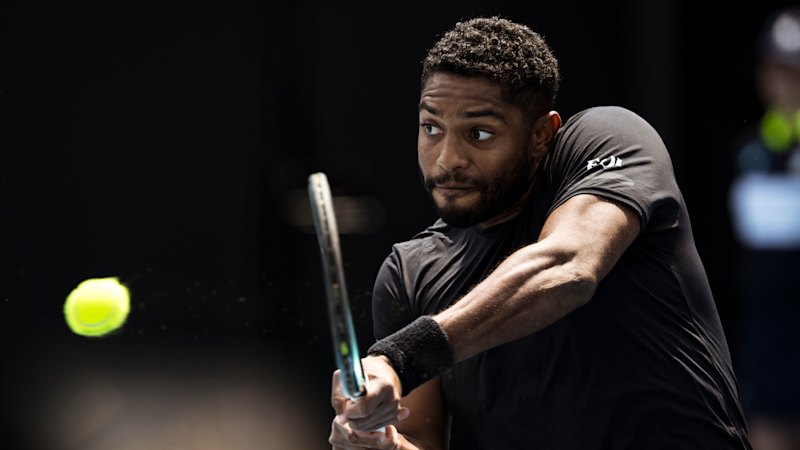
Brazil’s Joao Lucas Reis Da Silva made history at Melbourne Park on Monday when he became the first openly gay man to compete at the Australian Open.The world No.204 lost to Portugal’s Henrique Rocha in the first round of qualifying for the men’s draw, 6-2, 6-4, but his were a significant one hour and 18 minutes on court.Reis, 25, doesn’t necessarily consider himself a trailblazer, however. Little more than 12 months ago he simply posted a loving birthday message on social media to his partner that effectively acted as his way of coming out.“I didn’t think about it because I posted a picture with my boyfriend at the time,” Reis told this masthead.“We were together, we are together for three years, and [it] was his birthday, and I post a picture and everything like [changed].“But I took [the situation] on the positive way.“I received a lot of good messages, people supporting me and telling me that I’m an inspiration for them.“And this – this fills me up with good energy.”Reis was asked about breaking down boundaries in tennis – a sport with a countless number of players in the women’s game, current and former, who are openly gay, but with only isolated examples in the men’s game.Loading“Do I feel like a trailblazer, no I don’t,” he responded before pausing. “No I don’t.”Reis who plays predominantly on the ATP Challenger Tour circuit, came out in late 2024 – a time when his ranking was in the 400s, then enjoyed a fruitful 2025 season.The announcement came via posting a series of photos to his Instagram account, pictured in each with his partner, actor/model Gui Sampaio Ricardo.He said there was no strategy behind the timing, and he was prepared for the potential interest in his story.“When it came like news in the world, I thought that was going to be a lot of journalists that want to talk to me, but I didn’t want to talk with every one of them because I felt like there was a lot of pressure, you know, to change my life from one day to another,” he said.“And I didn’t want that. I just wanted to focus on tennis, and I feel like I managed pretty much well the last year because I focus on improve my game, and I feel like the ranking shows that I’m improving bit by bit, and that’s what I want to be doing this year as well.”Significantly, Swiss tennis player Mika Brunold followed his lead, choosing to also openly declare his sexuality last month.The 21-year-old, ranked in the high 300s, came out as gay when he took to Instagram and admitted that it was “time to open up and share” his sexual orientation with his fans.Reis is unsure why, in comparison to men’s tennis, there has been a readiness among WTA players to freely declare their sexuality.“Someone already asked me that question before, and ... I didn’t know how to answer, and I don’t know yet,” he said.“But, I mean … I came out like 2024 the December, and now there’s another guy [Brunold] that went that came out. So maybe, maybe it was because [we] didn’t have someone to come out first, I don’t know.”Brunold was clear in his belief about the importance of going public.After writing that he has spent “countless hours” working on all elements of his game and preparing for it, Brunold said that self-discovery has been the most important thing he’s devoted time to.“Through all of this, one of the most important things I’ve learned is that success on the court isn’t just about physical skill – it’s about discovering your personality and staying true to yourself,” he wrote on Instagram.Brunold went on to admit he felt he had to hide the fact that he was gay.“I’ve been thinking a lot about how to talk about this,” he wrote. “And while it hasn’t always been easy, hiding it and pretending to be someone I’m not was never an option.”Reis, who counted countryman Gustavo Kuerten, 2008 Australian Open finalist Jo-Wilfried Tsonga and one of the sport’s legends Rafael Nadal as his childhood heroes, is constantly appreciative of the strong support he receives from Brazilians when he’s playing either in his home country or away.“Yeah, they are like [very supportive],” he said.“I feel like people in Brazil love me, love to cheer on Brazilian guys, especially on these big tournaments. I saw some Brazilians in my court [today].“It was a small court [Kia Arena], but I heard a lot of people that are saying, ‘você pode conseguir’ – that’s ‘you can get it’ in Portuguese, of course, but yeah, well, that’s a good thing to hear.”


.jpg)
Most Popular