How a landmark ruling in chess could challenge Russia’s sovereignty over Ukraine

The history of chess is also Russia’s chequered past.Vladimir Lenin was obsessed as a young revolutionary; he saw chess as an intellectual pursuit which both sharpened his mind and provided respite from political struggle. In turn, Josef Stalin built chess schools across the Soviet Union in the 1930s as part of an extensive state sponsorship programme, turning the country into the game’s first superpower.Between 1937 and the end of the 20th century, there were just three years when a non-Soviet-born player was World Chess Champion. Grandmasters such as Mikhail Botvinnik, Mikhail Tal, Anatoly Karpov and Garry Kasparov are considered among the greatest and most creative chess players in history.Despite not producing a world champion for 18 years, this history is not dead in modern Russia.President Vladimir Putin and his family are known supporters of the game, while high-profile aides Dmitry Peskov, Putin’s spokesman, and Sergei Shoigu, the former minister of defence who led the 2022 invasion of Ukraine, have sat on national chess supervisory boards.In this sense, Lenin’s belief that chess and politics are separate is not quite true.Chess has always been political, not least in the famed ‘Match of the Century’ in 1972, a proxy Cold War fought between Russia’s Boris Spassky and the iconoclastic American Bobby Fischer. Now, a landmark decision at the Swiss-based Court of Arbitration for Sport (CAS) has reignited that history — a judgment which puts sport at the frontlines of Russia’s attempt to claim sovereignty over eastern Ukraine.“The practical effect is that the CFR (Chess Federation of Russia) cannot organise chess activities in the occupied regions,” says David Pinsky, the chief advocate for the Ukrainian Chess Federation at CAS. “But symbolically, it shows that no matter where the world’s attention shifts to, and no matter what the Kremlin thinks, these regions will not be considered part of the Russian Federation for the purposes of everyday life, for the things that people love — sports, culture, chess.”Ten years ago, Sergey Karjakin was a few moves away from becoming Russia’s most recent world champion.Born in Ukraine but ethnically Russian, he was eventually beaten in a sudden-death ‘rapid chess’ tie-break by Magnus Carlsen.Karjakin’s life has veered in a different direction since.Formerly the world’s youngest ever grandmaster, he switched nationality to Russia as a teenager in 2009, in part because it offered to finance his career, and the now 36-year-old has become one of the most public advocates in favour of the Russian invasion.He has enthusiastically parrotted Putin’s arguments, having worn T-shirts with the Russian leader’s face on as far back as 2014, and now serves as a Russian senator for Crimea, the region of his birth. In recent months, he posted videos from Avdiivka, an occupied village on the frontline, in which he played chess with Russian soldiers while delivering kit and equipment, while on another occasion he narrowly avoided a drone strike when travelling with the army.These activities saw him banned from chess for six months, before Karjakin embarked on a self-imposed exile over his inability to play under the Russian flag. Should he return to competition, his rating would likely see him return to the world’s top 10.Karjakin’s career shows how the Kremlin has weaponised chess.At that 2016 world championship in New York City, Danish grandmaster Peter Heine Nielsen had a direct involvement in the match as Carlsen’s coach. He describes to The Athletic how Peskov, Putin’s spokesperson, was regularly with them backstage.“It’s always been prestigious for the Soviet Union, and later Russia, to dominate in what is considered the most intellectual ballgame there is,” he explains. “So Peskov came to New York and sat in the dressing room with Karjakin, just five metres away during the play-off. There was huge interest from the Kremlin.”The president of the World Chess Federation (known as FIDE, using its French acronym) has been a Russian since 1995.Kirsan Ilyumzhinov, the sport’s chief from that year until 2018 — an oligarch who attracted notoriety after claiming he was once abducted by aliens — also served as president of the southern Russian province of Kalmykia. He was close to Putin, whom he invited to present the 2014 World Championship trophy to Carlsen, but Ilyumzhinov’s replacement, after he was sanctioned by the U.S. Treasury, was someone even nearer Russia’s seat of power.FIDE’s current president, Arkady Dvorkovich, served as Russia’s deputy prime minister from 2012 to 2018 under Dmitry Medvedev, one of Putin’s most rabid followers. Having initially criticised the decision to invade Ukraine, Dvorkovich quickly changed his views under political pressure, stating that he was “sincerely proud of the courage of our soldiers” and characterising members of the Ukrainian leadership as “Nazis”.Those comments — combined with his post-political career chairing the Skolkovo Foundation, now sanctioned by the United States due to its role in developing Russian military technology — led to a small group attempting to challenge Dvorkovich. Ukrainian grandmaster Andrii Baryshpolets ran against him unsuccessfully for the 2022 FIDE presidency — and also joined forces with Nielsen in a bid to legally challenge Russia’s continuing predominance in the sport, even amidst war.As well as attempting to argue Dvorkovich was breaching FIDE regulations by bringing chess into disrepute, Nielsen and Baryshpolets also focused on the CFR’s incorporation of chess bodies in occupied regions of Ukraine.Since the Russian occupation of Crimea in 2014, they have counted almost 3,700 tournaments organised by the CFR on land which the UN General Assembly recognises as Ukrainian. Over 6,000 players from these areas have been registered by the CFR in that time — the vast majority of them children. Karjakin has been guest of honour at several of these events.“It was shocking to realise how much activity there actually was in these occupied territories and how openly it’s done,” says Nielsen. “We could document this by just going on the CFR’s website — they were bragging about what they were doing. It’s completely unbearable, because it’s part of the process of changing Ukrainian identity into a Russian identity. That’s what soft-power means.”“They seized all the premises that belonged to the Ukrainian Chess Federation (UCF), all the chess clubs, and also automatically assigned the Ukrainian players in the region to be Russian,” adds Baryshpolets. “Many of them have no other option than to take Russian passports. FIDE had not reacted at all.”In June 2024, FIDE’s ethics commission largely found in the protestors’ favour — threatening Russia with a two-year suspension and formally reprimanding Dvorkovich for his comments. It was a success, of sorts.But then, just three months later, an appeal completely flipped that narrative — ruling that while the CFR was guilty of violating Ukrainian sovereignty, the Russian body should pay a fine of just €45,000 rather than face suspension. Dvorkovich’s reprimand was also completely revoked.Much of the chess community was incensed.Kasparov, a Russian grandmaster turned critic of Putin, and the second-highest rated chess player in history, called FIDE “a frequent tool of the Russian regime… using chess for unaccountable, quasi-diplomatic power and propaganda.”Nielsen and Baryshpolets, meanwhile, were desperately disappointed.“Although we had won on paper, it was horrible for us,” says Nielsen. “They could just pay that amount and continue their breaches — when we first started researching this, the CFR were just putting on tournaments, but after this appeal they started incorporating them legally as well. While the FIDE system has handed out numerous suspensions for considerably smaller offences, now, for the first time in history, was this idea to give a fine. It struck us as a judicial intervention to save chess’ biggest federation.”“This fine implies that you could do whatever you liked on the occupied territories and just pay a small amount,” adds Baryshpolets. “It practically legitimised all those activities, with no consequences.”Their last recourse was to appeal to CAS, Europe’s most powerful sporting court.Having largely represented themselves against the might of the Russian state over the previous months, Nielsen and Baryshpolets linked up with the UCF and received pro-bono legal aid from American firm Covington & Burling.“It’s important contextually to note that at no point in this process has the CFR disputed that it held hundreds upon hundreds of chess activities in the occupied regions of Ukraine,” says Pinsky, a partner at Covington. “It wasn’t a technical violation.”Having reached a decision earlier this month, CAS publicly released the appeal verdict on Friday — in Ukraine’s favour.The three-person body found that a fine “is completely inapt to the nature and gravity of the CFR’s violations”, while also noting Russia’s lack of “contrition”, failure to consult FIDE and refusal to allow players in the region to self-determine their representation. “The CFR’s historic contribution to chess, while beyond doubt, is wholly irrelevant to the violations at issue here,” they added.CAS duly ordered the CFR to halt all chess activities in five annexed regions within 90 days — Crimea, Donetsk, Luhansk, Kherson and Zaporizhzhia, as well as the city of Sevastopol — and to publicly announce it had done so. If it fails to comply, the CFR will be suspended from global chess for a minimum of three years.The federation’s leaders, and the Kremlin, now face a decision. They can either observe these orders from CAS, which would mean effectively ceding sporting sovereignty over an area which Putin insists is rightfully Russian, or face being barred from the sport the present regime holds most dear.“Russia have been desperate to get their teams back into tournaments,” says Nielsen. “They finally succeeded recently, but now, if they are suspended, they cannot play in the FIDE tournaments they dreamed of. But of course, it’s also been a huge matter of prestige that they’ve been doing these tournaments in occupied Ukraine. Russian law was, to some extent, obliging them to do it.”The burden is now on Russia to dissolve its chess presence in Ukraine — CAS does not enforce its own awards — with any failure to do so leading to a FIDE suspension, or, if chess’ governing body does not immediately comply, an order in a Swiss court.Over recent months, global trends have seen a slow reintroduction of Russian athletes into sport. Most controversially, at this month’s Winter Paralympics, Russia finished third in the medal table as it competed at Olympic level under its own flag for the first time in almost a decade. Nations skipped the opening ceremony and athletes turned their backs on Russian rivals on medal podiums in protest.Beyond the world of chess, this CAS decision has implications for sport at large.“Ultimately, the decision stands for the proposition that no Russian sporting federation — whether chess, whether hockey, whether basketball, whether football — is permitted to organise their sports and regulate their activities in occupied regions of Ukraine,” explains Pinsky.Last Wednesday, state media reported that the Russian Olympic Committee had already dropped references to occupied Crimean regions from its statutes — an issue that had seen them suspended by the International Olympic Committee in 2023. It is currently unclear whether this is a direct repercussion of the CAS verdict, but the timing appears more than coincidental.“This was one of the reasons we wanted to appeal to CAS,” adds Nielsen. “If Russia has to be allowed to come back into sports, they have to comply with the rules.”A flick of a lawyer’s pen now leaves Russia’s propaganda machine divided.They can either continue to compete in global sport, with all the soft-power benefits that offers, or conspicuously weaken their own claim on eastern Ukraine by ceding to international law that those regions are not Russian.Which is more important? Putin cannot play as both black and white.
.jpg)
.jpg)
Most Popular

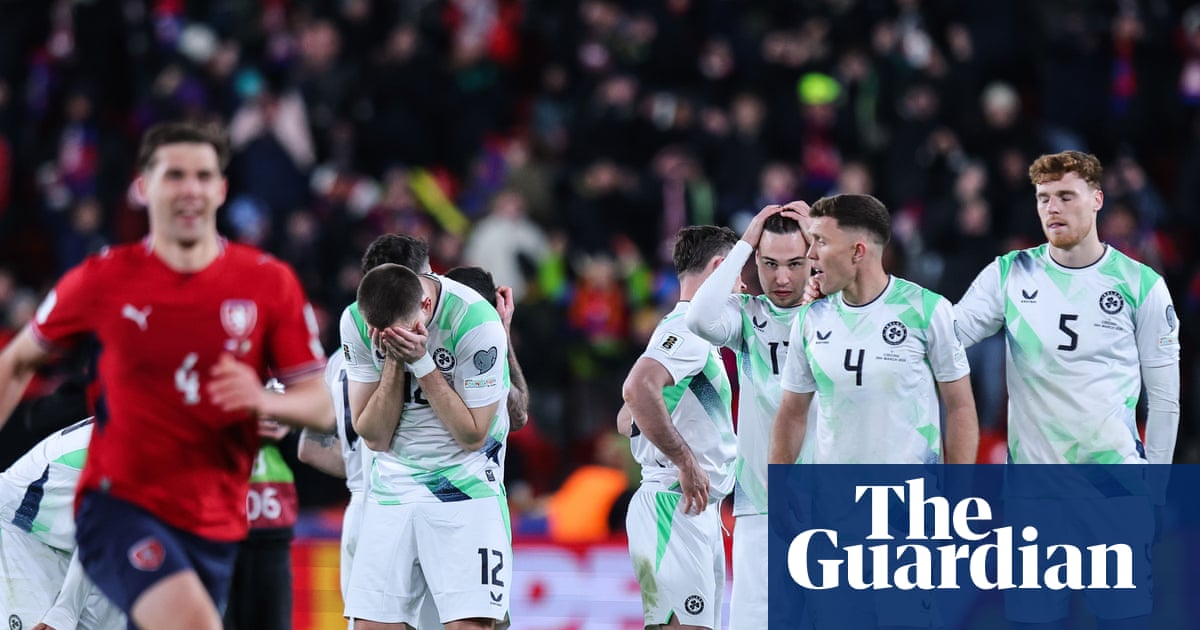
Hallgrimsson devastated by Irish loss
11 hours ago