
Australian Open Day 1 recap: Carlos Alcaraz starts pursuit of career Grand Slam

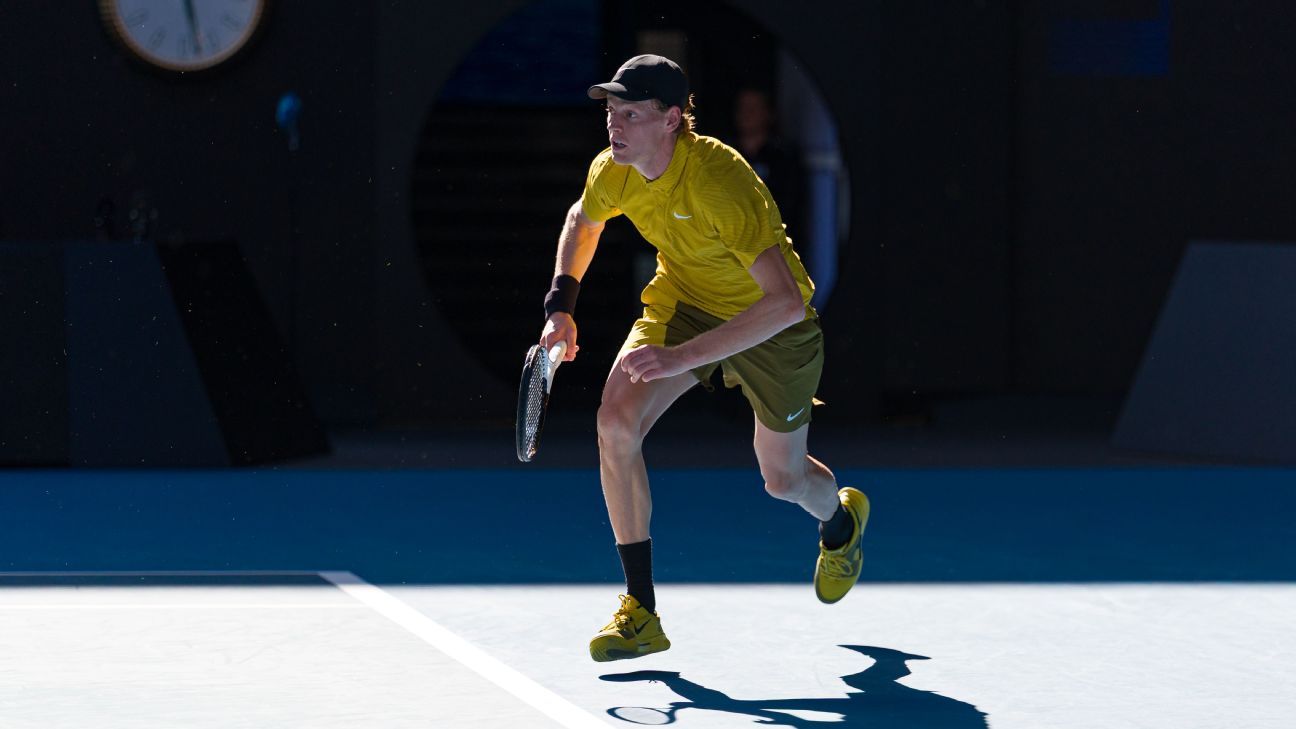
To follow all of The Athletic’s Australian Open coverage, click here.Welcome to the Australian Open briefing, where The Athletic will explain the stories behind the stories on each day of the tournament.On Day 1, a pursuit of a career Grand Slam began, one of the strangest matches in recent memory unfolded, and there was a dose of tennis politics.A smooth start in pursuit of history?Carlos Alcaraz is in Melbourne for one thing: the career Grand Slam that would come with winning the Australian Open title. Even after his icily clinical performance to win the U.S. Open last September, everything else is noise. Winning seven matches is what he is here to do, however they come.Sunday night on Rod Laver Arena, Australia’s Adam Walton gave him not a fright of any kind, but a test. He made 93 percent of his first serves in the opening set — an absurd number — and hit a first serve on every single break point he faced during the match. He scampered and redirected pace and made Alcaraz work, imposing enough pressure to earn a break of serve in the second set and take a 3-1 lead.In his first Grand Slam tournament since splitting with Juan Carlos Ferrero, with whom he won six of them, Alcaraz looked… entirely unbothered. He broke back straight away, held serve comfortably as Walton’s level slowly started to come down, and accelerated away with a tiebreak at 6-6 to break his opponent’s resolve and dampen the cheers of the hopeful home crowd. By the third set, Alcaraz was largely purring, and Walton could no longer hope to live with him.“He moves a bit different to the rest of the guys on the tour,” Walton said in his news conference.“When the draw comes out, you’ve got to play with the person on the other side of the net.”Walton did just that for two sets, with Alcaraz giving him credit for his ability to look for opportunities to attack, as well as his shift to a more aggressive brand of tennis in the second set.“I had to manage myself to be ready for that battle,” Alcaraz said.“He was trying to find positions to attack whenever he could.”— James HansenWill there be a more dramatic match?There are highlights of Marta Kostyuk and Elsa Jacquemot’s first-round match on the internet, but a three-minute package cannot do justice to an Australian Open encounter that truly had it all.Ukraine’s Kostyuk was coming off an emotional, thrilling run to the Brisbane International final, after which she described traveling around the world knowing her country remains in turmoil through Russia’s invasion.It looked set to continue when she led 7-6(4), 5-3, but Jacquemot had other plans and dragged Kostyuk into another tiebreak and then a third set.From there, strange things started to happen. In that third set, Kostyuk lost two points on serve in five service games. Jacquemot lost 19 in her six service games, saving 7 break points and playing out several seesawing deuces in which both players endured hard-to-describe misses. There was self-flagellation in abundance, Jacquemot seething openly at her box and Kostyuk asking herself what she was doing and how and why.Then, in Kostyuk’s sixth service game, disaster struck. Moving to her left, she heavily twisted her ankle, falling to the ground before hobbling to the side of the court. Jacquemot, who was exerting pressure and trying to prevent a third tiebreak, stood at the side of the court as trainers bandaged and taped Kostyuk’s ankle.She came back and held serve to go to one last tiebreak. From there, chaos reigned. Kostyuk missed a sitter volley to go behind early, before catching up to a poor drop shot in spite of her ankle, only to casually waft a short backhand wide. Jacquemot led 5-1, 5 points from victory.The error bug crossed the net again and Kostyuk got back first to 5-4, and then to 7-7. She had the momentum. And after nearly three hours and 30 minutes of absorbingly error-strewn tennis, Jacquemot found her two cleanest forehands of the entire match, crushed straight down the line, to move up 9-7.Of course, it didn’t end that way. Kostyuk sized up a short ball, inexplicably chose a drop shot, and flopped it into the net, to leave Jacquemot celebrating the biggest, strangest victory of her career in the first Australian Open women’s match of the Open Era to go to three tiebreaks. 6-7(4), 7-6(4), 7-6(7), the scoreline read. Like the highlights, it does not come close to telling the story.— James HansenA political revelation on the eve of the tournament?On the eve of the Australian Open, Tennis Australia and the Professional Tennis Players’ Association revealed details of their settlement in the sprawling lawsuit against the Grand Slams and ATP and WTA Tours.The Australian Open organizer is not paying any damages to the PTPA, but it will pay $50,000 in costs. Instead, the key to the settlement is that Tennis Australia will effectively switch sides, assisting the PTPA with its case against the other majors and tours by “providing valuable discovery that [the plaintiffs] may or may not have been ultimately able to obtain from Tennis Australia, which Damages Class Plaintiffs can use in litigating their claims well in advance of Court-ordered discovery against ATP and WTA,” per the filing.Any discovery against the other three majors is pending their motions to dismiss the suit, so will happen later.The Australians, led by Craig Tiley, have allied themselves with the PTPA during the past two years because of shared views about the need to streamline the schedule of the sport. The other three majors share these views, as do the ATP and WTA, but there is disagreement on how it should be achieved and in what form.Their agreement to help the PTPA is also useful for the organization in a symbolic sense. It can also serve as a tool of leverage and pressure against the other adversaries to reach their own settlement deals rather than facing potential damages and the expense of litigation.— Matt FuttermanAnd a villainous celebration?The Australian Open is a tournament of tennis diasporas, with numerous nations from all over the world turning out in their droves to support their own. Brazil — whose tennis fans follow their players all around the world — is no exception, and Beatriz Haddad Maia had all the flag-waving, exuberant support she could handle for her match against Yulia Putintseva of Kazakhstan.Putintseva was not such a fan of the noise, so when she won the match in three sets, there was only one thing to do. To best enjoy this stunning celebration, follow the creed that Putintseva very clearly does not: Sit back and observe. Not everything needs a reaction.Oh — sound on.Other notable results on Day 1:Flavio Cobolli, the No. 20 seed, lost in straight sets to British qualifier Arthur Fery. The Italian told physios that he was struggling with diarrhea from the third game of the match, and Fery was ruthless in a 7-6(1), 6-4, 6-1 win.Aryna Sabalenka (1) eased past wild card Tiantsoa Sarah Rakotomanga Rajaonah after a challenging start, 6-4, 6-1.After interrupting play to help a ball kid who had collapsed, Turkish qualifier Zeynep Sönmez took out Ekaterina Alexandrova (11) 7-5, 4-6, 6-4, coming from 0-3 in the third.Alexander Bublik (10) came through a tricky test against Jenson Brooksby with a consummate 6-4, 6-4, 6-4 display of keeping an opponent at arm’s length.And Emma Raducanu (28) recovered from an early wobble to beat Mananchaya Sawangkaew 6-4, 6-1.Shot of the dayMaria Sakkari was playing early, but she didn’t give anyone a chance to do better than this squash-shot forehand return — as indicated by her disbelief at her own genius.Drop Shots📖 With so much tennis to be played in the next fortnight, here are the key storylines to watch⚔️Who will the favorites for the titles have to face en route? Get all your draw analysis here.⏰ The Australian Open is famous for late nights, but Emma Raducanu has a familiar gripe with its schedule and how it affects women’s players more than men.🤦♂️And sorry to Sebastian Ofner, but we have to revisit the case of the player who celebrated too early — and then lost.Up next: First round continues🎾 Men’s singles: Nuno Borges vs. Félix Auger-Aliassime (7)7 p.m. ET on ESPN Unlimited, ESPN+Auger-Aliassime’s resurgence in the back half of 2025 was one of the stories of men’s tennis, as he surged to the U.S. Open semifinals. Nuno Borges, the Portuguese with a penchant for long, tense Grand Slam matches, will be a tough first out in Melbourne.🎾 Women’s singles: Coco Gauff (3) vs. Kamilla Rakhimova7:30 p.m. ET on ESPN Unlimited, ESPN+Is Coco Gauff the strangest 21-year-old, two-time Grand Slam champion ever? She can win just about any match through sheer force of will, athleticism and tennis smarts, but most of those wins threaten to teeter into the abyss thanks to her shaky serve and forehand.🎾 Women’s singles: Barbora Krejčíková vs. Diana Shnaider (23)1 a.m. ET Jan. 19 (estimated) on ESPN2The first-round banger between a mid-range seed and a very dangerous unseeded player is a feature of this year’s draw on both sides. Here, two-time Grand Slam champion Krejčíková is up against Shnaider, a rising Russian talent.🎾 Women’s singles: Donna Vekić vs. Mirra Andreeva (8)3 a.m. ET Jan. 19 on ESPN2And same again here, with Vekić, the 2024 Paris Olympics silver medalist, against Andreeva, the most talented teenager in the women’s game.Australian Open men’s draw 2026Australian Open women’s draw 2026Tell us what you noticed on the first day…
.jpg)
Most Popular


Will Scotland replace Bangladesh at T20 World Cup?
11 hours ago
U19 World Cup: Scotland slump to 176-7 in 43 overs
12 hours ago